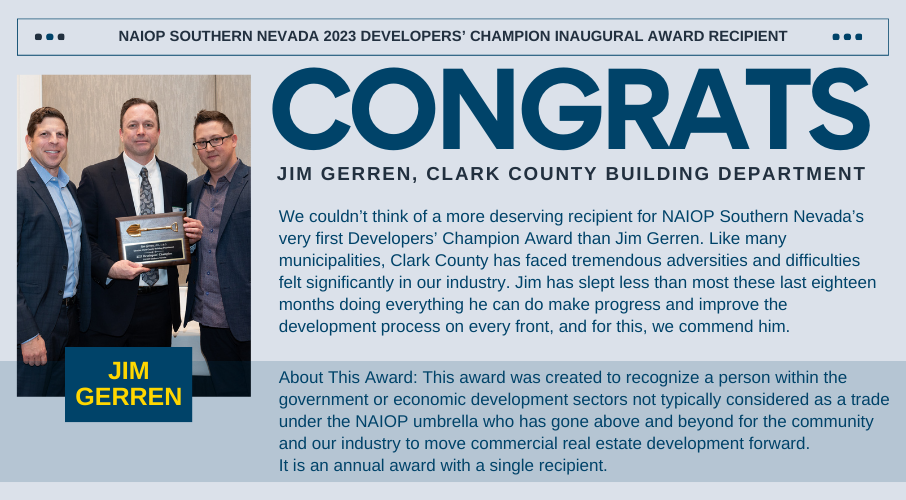
Clark County Recognizes the Director of the Clark County Building Department, Jim Gerren, at the Clark County Board of Commissioners Meeting For His Receipt of 2023 NAIOP Southern Nevada Developers’ Champion Award.
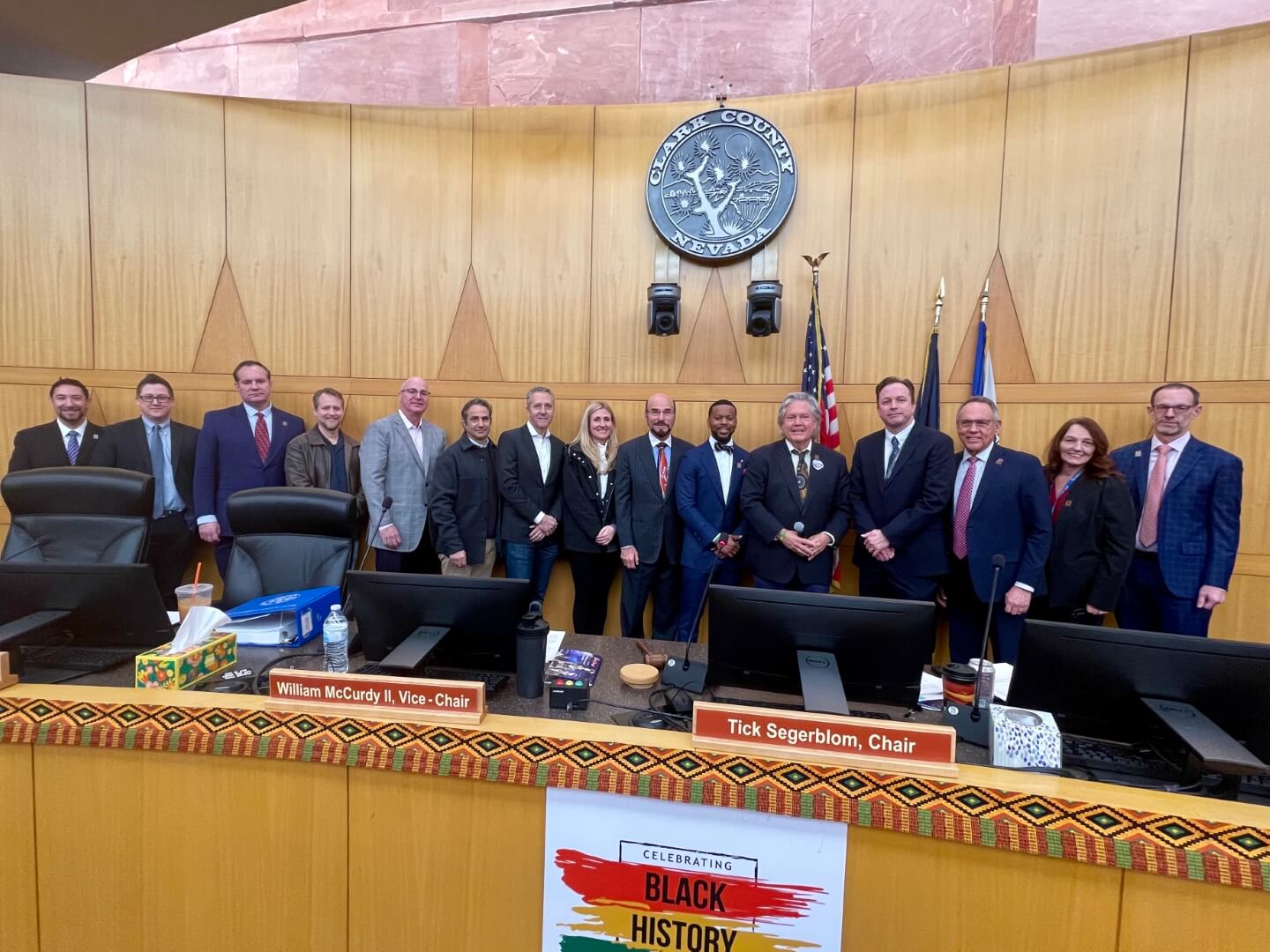

Clark County Recognizes the Director of the Clark County Building Department, Jim Gerren, at the Clark County Board of Commissioners Meeting For His Receipt of 2023 NAIOP Southern Nevada Developers’ Champion Award.
The 2023 Post Legislation Session review is here.
Jon Leleu
Attorney/Lobbyist
Argentum Partners
jleleu@argentumnv.com
Kerrie Kramer
Lobbyist
Argentum Partners
kerrie@argentumnv.com
Together again
Gee, it’s good to be together again
I just can’t imagine that you’ve ever been gone
It’s not starting over, it’s just going on
Together again
Now we’re here and there’s no need remembering when
‘Cause no feeling feels like that feeling
Together again
– The Muppets
Endearing, isn’t it? Indeed, driving through Washoe Valley on the way to Day 1 of the 2023 Nevada Legislative Session had that unmistakable feeling of comfort and familiarity. Despite the fact that the Governor, the Lieutenant Governor, and more than 20 of the 63 Legislators had never experienced a live legislative session, we were anxious to see our friends, work with our long-standing coalitions, and actually attend a live lobbying meeting for the first time since 2019. Yet, all good things must come to an end, and shortly after the gavel commenced the 2023 Session, our happy Muppets earworm quickly gave way to the mutually-assured destruction message from “Beat It”:
Just beat it, beat it
No one wants to be defeated
Showin’ how funky and strong is your fight
It doesn’t matter who’s wrong or right
Just beat it
– Michael Jackson
As the interests of the state gave way to national political talking points and political infighting within and between the parties, the Assembly, the Senate, and the Governor’s office, the Carson faithful hunkered down for a long, bruising session. It should come as no surprise, then, that when the dust settled on sine die, very little was accomplished. Although legislative Democrats were quick to pillory Governor Lombardo for shattering the “record” for vetoes in a single session, very little mention has been made of either the plague-like attrition of legislation throughout the session, or the volume of awful policy which the legislature sent to the Governor’s desk, necessitating “the power of the pen.” And while the number of vetoed bills is high, so too is the hubris in expecting that all bills passed by the legislature should be signed by the Governor, a separate but co-equal branch of government.
The numbers are eye-opening:
– BDR”s – 1,234
– Total Bills Introduced – 1,044
– Bills Passed and Sent to Gov. Lombardo – 610 (58%)
– Bills Signed – 535 (88%)
– Bills Vetoed – 75 (12%)
By any measure, the 2023 Nevada Legislative Session will be remembered for its missed opportunities, as Nevada electeds invariably chose politics over state interests on nearly every issue. Indeed, even the appropriations bill for capital improvements was unable to escape partisan gamesmanship, as the Senate failed to pass the bill by sine die, requiring a special session to be held such that the budget could be fully funded; a constitutional mandate. Over and over, bills that passed were either unanimous or party-line; a key indicator that caucuses are dug-in and bills are not being negotiated. And while the parties may point to their respective “wins,” reality is actual progress for the State of Nevada was minimal, and Nevada’s unique 120-day biennial legislative session prevents further action until 2025, widening the chasm between where Nevada needs to be as a state in the 21st century, and where it ended up after sine die on June 6, 2023.
Jon Leleu
Attorney/Lobbyist
Argentum Partners
jleleu@argentumnv.com
Kerrie Kramer
Lobbyist
Argentum Partners
kerrie@argentumnv.com
“Blow, blow, thou winter wind Thou art not so unkind, As man’s ingratitude.”
– William Shakespeare
Storms pounding the pacific northwest. Accumulation measured in feet. “Atmospheric River” is again part of daily conversation. Odd year. Jon’s grumpy(ier). Kerrie’s resolution to clean up her language died 2 weeks ago.
It must be time for another Legislative Session.
But while certain constants remind us of what is to come, such as Kerrie’s texts increasingly mentioning waterfowl, certain changes give hope that some things will be different.
The election of Joe Lombardo as Governor is one of those changes, and a direct message from the voters to the parties that candidates matter; platform matters; and to borrow one from Ralston, #wematter. While the national stage is important, there are larger issues at home, and it is time to start dealing with these things, as opposed to hastily adopting poorly conceived legislation simply to waive around a “vanity plate.”
On January 23, 2023, Governor Lombardo sent a message to Nevadans on his way out the door, when he responded to a reporter’s question of what he was most looking forward to as Governor by muttering into a hot mic, “getting sh*t done.” The message, combined with the more formal speech, could not have been more clear: budget surplus, but mitigated and targeted spending, dollars spent will come with accountability, and almost seemingly answering NAIOP’s mantra for the last several years, provide actual executive leadership in the two most critical issues facing Nevada – water and land. And while these resources are regulated by the federal government, Governor Lombardo made plain his intent to roll up his sleeves and “get sh*t done.”
And so, as Jon and Kerrie delve into pre-filed bills and track BDR’s, we do so with a different set of “eyes.” Bills and BDR’s put forth seemingly assuming a “rubber stamp” will likely not be as easy to move. Legislation assumed to be DOA suddenly has a pulse. And Carson City, sure as the winter snow will fall, will come to life with new relevance in 2 short weeks.
We look forward to seeing you in March.
Jon Leleu
Attorney/Lobbyist
Argentum Partners
jleleu@argentumnv.com
Kerrie Kramer
Lobbyist
Argentum Partners
kerrie@argentumnv.com
Dear Principal Members and President Circle Sponsors,
This email is a follow up to the Government Affairs Alerts sent in December and January regarding the proposed Evaporative Cooling Systems ban. As you may be aware, on December 8, 2021, Clark County proposed a ban on all evaporative cooling systems. On December 20, 2021, the Southern Nevada Water Authority Board passed a resolution supporting a county-wide moratorium on the use of evaporative cooling systems. This resolution directed all local jurisdictions to begin working toward ordinances and/or other administrative measures (through procedure, building codes, or otherwise) that would no longer allow evaporative cooling systems to be used for any new commercial project.
At this time, no ban or moratorium has officially been placed into effect at any local municipality, although Clark County has already begun inserting advisory language into all “Notice Of Final Action” letters for new projects that such systems will be banned. Here is an example of that language (submitted to us by a NAIOP member):
“Applicant is advised that the installation and use of cooling systems that consumptively use water will be prohibited.”
In response to these actions, the NAIOP Southern Nevada Government Affairs Committee formed a subcommittee tasked with managing this issue and working with industry and community stakeholders to both advocate for the commercial real estate industry and educate and inform community leadership of potential economic impacts.
Within the first several weeks of the new year, it became clear from several conversations and inquiries that our elected officials and the Southern Nevada Water Authority Board needed to hear from our industry on the issue. The subcommittee drafted the attached letter, which was sent to every commissioner, councilperson, and mayor in Southern Nevada. Additionally, local trade organizations responsible for economic growth in Southern Nevada received a copy of the letter.
As we move forward with DRI studies, we will also be reaching out to our principal members for additional information that we will need in order to complete Economic Impact Summaries. We ask that our principal members be ready to help NAIOP in the coming weeks.
There is no doubt that our region is currently experiencing a drought worse than experts expected. It would be reasonable for our members to expect numerous changes in the coming months and years regarding how our community uses water. It is our job to advocate for our industry in a manner that is considerate of our community’s best interests, as community leadership attempts to navigate current climate realities.
Should you have any questions or comments, please do not hesitate to contact chapter leadership.
Thank you.
Hayim Mizrachi
Chapter President
NAIOP Southern Nevada Chapter
(702) 941-7376
hmizrachi@mdlgroup.com
Steve Neiger
Government Affairs Chair
NAIOP Southern Nevada Chapter
(702) 836-3760
steve.neiger@colliers.com
Please be advised that Clark County Building Department has recently discovered an error in how some fence permit fees were being calculated. Fees were being calculated on a lower project valuation number; resulting in a lower permit fee being charged.
Effective January 3, 2022, this calculation error has been corrected. As a result, please be advised the permit fees for fence permits issued on or after January 4, 2022 may be higher.
We apologize for any inconvenience this may cause.
Click here for the notice.
Respectfully,
Jerome A. Stueve, P.E.
Director/Building & Fire Official
jerry.stueve@clarkcountynv.gov
Happy Holidays!
2021 brought tremendous yuletide cheer, not only was there an infrastructure week, but multiple infrastructure bills. And, may our hearts be still, one of them actually passed!
The following bifurcation from the controversial “Build Back Better Act,” the hard infrastructure bill was signed on November 15, and is 2,700 pages in length. Generally, the bill appropriates $1.2T, $550B of which is new spending, to traditional infrastructure projects over the next five years.
The categories of federal spending are, generally, as follows:
Some of this spending goes to federal agencies to fund existing programs or, in some cases, mandates agency rulemaking to create programs. For instance, the bill makes direct, supplemental appropriations to several federal agencies:
Some of the spending goes directly to states for the same purposes – fund existing programs/projects or requires the establishment of same. As you know, the Nevada Legislature is not in session, so in many (if not most) cases, the statutory framework to manage the appropriation of these funds may not be in place. This will happen either in the Interim Finance Committee or in 2023.
With respect to funds to be received by Nevada, the overall economic impact is estimated at ~$4 billion, and the White House analysis notes the following categories and spending over five years:
The White House also notes additional economic impact data is coming and will be updated.
State and local elected officials are already issuing press releases regarding spending of the funds, however, as noted, the funds have generally not yet been appropriated, and in many cases, the programs which will be funded with this money aren’t yet in place. This will happen shortly, likely over the next several months.
We wish all of you a safe and restful holiday season and look forward to a very successful 2022!
Jon & Kerrie
Jonathan Leleu, Lobbyist/Attorney
jleleu@argentumnv.com
Kerrie Kramer, Lobbyist
kerrie@argentumnv.com
Argentum Partners
(702) 692-8037