
Debt Market Survey, Second Quarter 2026
Release Date: August 2026
A Market Leaning Back Toward Fixed-Rate Loans
Data from Altus Group’s second-quarter 2026 survey of commercial real estate (CRE) borrowers and lenders point to a market where the source of relief has shifted. Treasury yields climbed, pushing fixed-rate all-in costs higher, while the Secured Overnight Financing Rate (SOFR) flattened after several quarters of decline. That left floating-rate borrowers relying on spread compression rather than a falling base rate. Quote activity ticked down slightly after the first quarter’s rebound, and the product mix tilted back toward fixed-rate products, led primarily by short-term fixed-rate debt. Spreads narrowed across most of the market, with the sharpest compression occurring in floating and mezzanine products, while quote activity shifted toward office and retail and away from industrial loans.
Market Activity
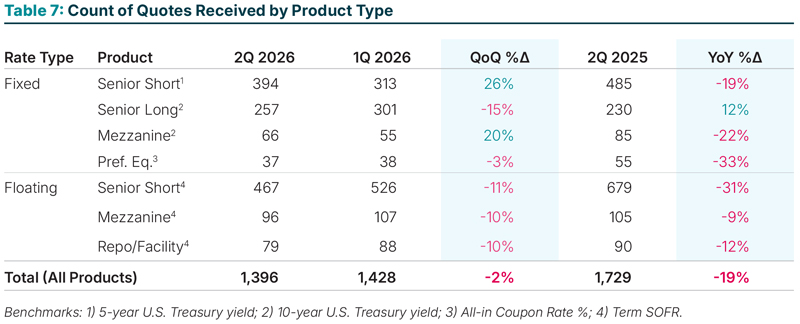
Quote volume eased in the second quarter. Survey participants reported 1,396 quotes, down about 2% from the first quarter’s 1,428. The pullback was modest, leaving activity near recent levels after a strong first quarter. Year over year, volume remains 19% below the 1,729 quotes logged in the second quarter of 2025.
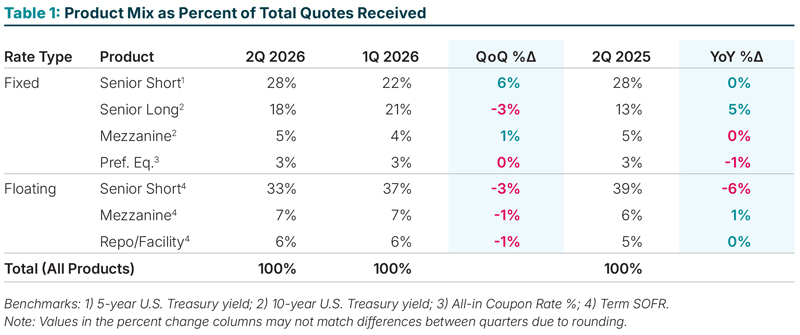
The product mix tilted toward fixed-rate products, which made up 54% of quotes versus an even 50/50 split between fixed- and floating-rate in the first quarter. The clearest move was in fixed-rate senior short-term loans, which rose to 28% of quotes from 22%, while fixed-rate senior long-term slipped to 18% of quotes from 21%. Floating-rate senior debt remained the most quoted product at 33%, down from 37%.
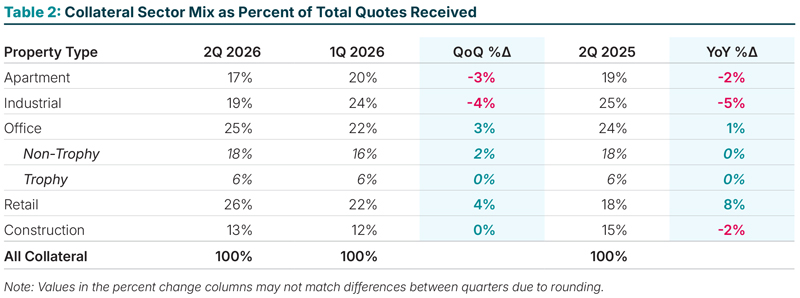
The collateral mix shifted meaningfully between the first and second quarters of 2026. Retail led all sectors, capturing 26% of quotes, up from 22%. Office climbed to 25% from 22%, into the No. 2 spot. Industrial, the most quoted sector in the prior quarter, dropped to 19% from 24%. Apartment eased to 17% from 20%, and construction held near 13%. The increase in office and retail quotes is worth watching because these sectors tend to price wider than apartment and industrial and may pull the market-wide averages higher as a result.
Benchmark and Spread Trends
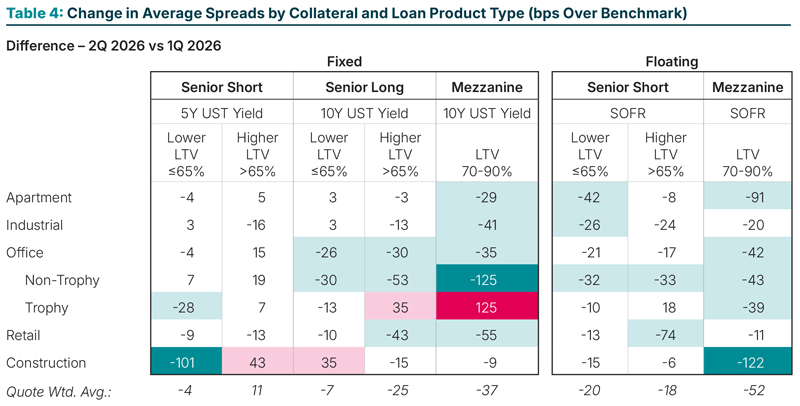
Benchmarks kept moving against fixed-rate borrowers in the market for financing. The 5-year U.S. Treasury yield averaged roughly 4.09% during the second quarter, up about 32 basis points (bps) from the first. The 10-year Treasury settled near 4.42%, up about 22 bps. SOFR barely moved, easing around 4 bps to 3.62%. The decline in SOFR that drove floating-rate relief through late 2025 and early 2026 has stalled, but spreads compressed in the second quarter. On a quote-weighted basis, floating-rate and mezzanine spreads led the narrowing, while fixed-rate senior short-term spreads held roughly flat. That said, through the second quarter, market consensus shifted from anticipating additional rate cuts to pricing a greater risk of further tightening. This shift in market expectations helps to explain the renewed quoting activity for short-term fixed-rate financing.
Apartment and Industrial Holding Tight
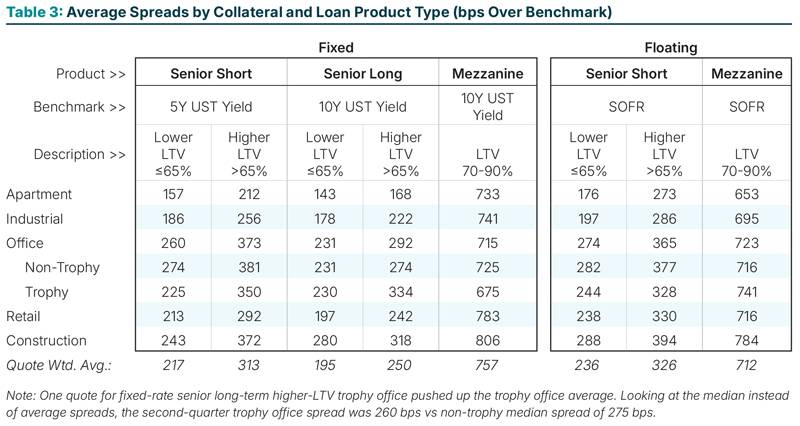
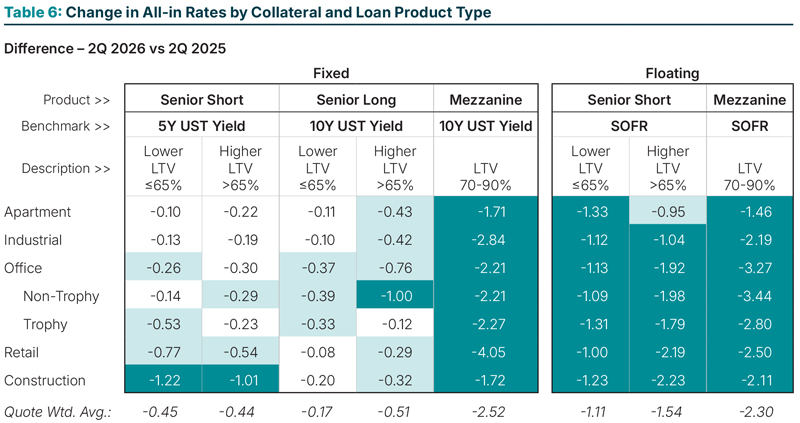
Apartment spreads stayed the tightest in the market. Senior long-term fixed-rate loans on apartments priced at 143 bps over the 10-year Treasury for lower-leverage deals, remaining essentially flat quarter over quarter. Industrial came in at 178 bps for the same product and leverage, also largely unchanged. The largest moves occurred on the floating-rate side, with apartment senior short-term spreads tightening 42 bps and industrial repo/facility spreads dropping 46 bps.
Office Compresses on the Long End
Office quotes reveal a mixed picture. Senior long-term fixed-rate spreads compressed, tightening about 30 bps for lower-leverage non-trophy deals to 231 bps. Floating-rate spreads narrowed as well. But fixed-rate senior short-term spreads held firm to slightly wider, with higher-leverage readings pushing up. That partly reflects a jump in office fixed-rate senior short-term quote volume, which shifts the composition of the office average. The trophy versus non-trophy gap is worth noting. For lower-leverage senior long-term fixed-rate loans, the two priced within a basis point of each other, continuing the narrowing trend observed over the past several quarters. A few wider trophy readings sit on very thin quote counts and read as noise rather than signal. For this reason, the divergence in fixed mezzanine quotes for non-trophy and trophy office properties can be taken with a grain of salt.
Retail Spreads Narrow
Retail reversed course from the prior quarter, when spreads had widened. In the second quarter, they tightened. Higher-leverage floating-rate senior spreads tightened 74 bps, and higher-leverage senior long-term fixed-rate spreads narrowed 43 bps. The pullback lines up with retail’s jump in quote share and suggests lenders became more active after the prior quarter’s recalibration.
Construction Widest, but Mixed
Construction remains the widest-priced corner of the market, and its readings stayed volatile. Lower-leverage senior short-term fixed-rate spreads dropped 101 bps to 243 bps, but the quote count behind that bucket more than doubled from the prior quarter, so the move likely reflects sample composition more than a clean pricing shift. Fixed-rate mezzanine held near 806 bps, still the highest across all collateral types. Given the limited quote volumes, these readings are best treated as directional.
All-in Rates
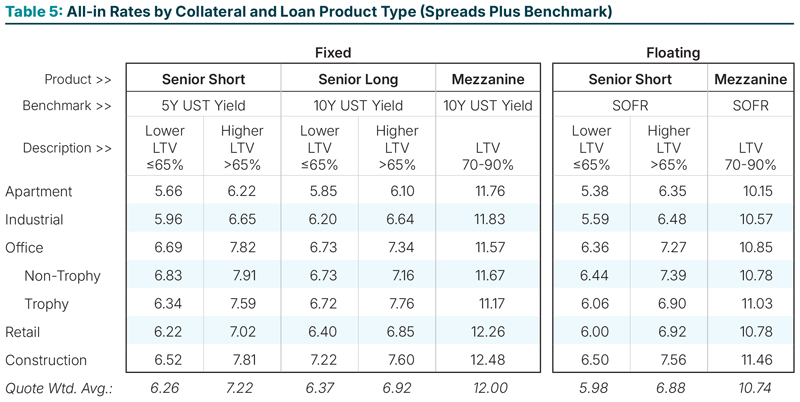
The split between rising Treasury yields and flat SOFR produced a clear divide in the cost of capital across products. Fixed-rate all-in costs rose, led by senior short-term loans tracking the 5-year Treasury higher. Fixed-rate senior long-term costs came in closer to flat, as spread compression offset most of the 10-year benchmark’s rise. Floating-rate costs fell across nearly every property type, driven by tighter spreads rather than a lower benchmark rate.
For apartments, lower-leverage senior long-term fixed rates rose 25 bps to 5.85%, while floating-rate senior loans dropped 45 bps to 5.38%. Industrial followed, with fixed senior long-term at 6.20% and floating-rate senior down 30 bps to 5.59%.
Office all-in costs improved on both the fixed long end and the floating side. Lower-leverage senior long-term fixed rates edged down 4 bps to 6.73% as spread compression more than offset the benchmark rise, and floating-rate senior costs fell 25 bps to 6.36%. Construction stayed the most expensive part of the market, with lower-leverage senior long-term fixed rates rising to 7.22% and floating-rate senior costs easing to 6.50%.
The upshot is a wider gap between fixed and floating than borrowers faced a quarter ago. For lower-leverage senior debt, floating now prices below fixed across every major sector. Apartment floating-rate runs about 48 bps under comparable fixed-rate products, industrial about 61 bps, and office about 37 bps. In the first quarter, those gaps were slim or reversed, and apartment floating-rate financing priced above fixed. What changed is the driver of that fixed-vs-floating rate gap. In the prior quarter, floating looked cheaper because SOFR was falling and expected to fall further. This quarter, it looks cheaper because fixed got more expensive, driven by the benchmark yields. For borrowers deciding whether to lock in a rate, that distinction matters. The floating-rate advantage now depends on rates remaining stable, leaving borrowers more exposed if the Federal Reserve adopts a more hawkish stance than expected. A fixed-rate product costs more today but removes that risk. Neither is the clear choice, and the right call turns on the hold period and the borrower’s read on the rate path from here.
Looking Ahead
Second-quarter data show a CRE financing market that remains steady despite a stubborn rate backdrop. The data reflect the daily reality of getting deals financed; the easy tailwind is gone. Falling SOFR helped lower borrowing costs for more than a year, but that source of relief appears exhausted for now. At the same time, higher Treasury yields have made fixed-rate financing more expensive than it was in the spring.
There is a silver lining: Lenders appear to be leaning back in. Office spreads narrowed on the long end, the trophy gap all but closed, and retail moved to the front of the quote board as its pricing tightened. Credit tends to warm to a sector before values fully reset, so owners and developers weighing those sectors may find debt more available than the headlines suggest. Construction financing remained expensive and was the most uneven corner of the market, a reminder that lender appetite for ground-up development risk remains selective. The practical approach is to underwrite to rates near current levels rather than counting on a hoped for and increasingly less likely rate cut, to keep fixed-rate exposure short where refinancing optionality has value and to treat further spread tightening as a potential upside rather than base case.
About the Survey
This report draws from a sample of data from U.S. respondents to Altus Group’s CRE Debt Capital Markets Survey, a quarterly industry survey collecting anonymized data from borrowers and lenders on commercial real estate debt pricing, loan terms, origination volumes, collateral values, leverage and other metrics across the U.S. and Europe to improve transparency and provide benchmarking insights. Survey participants are provided with access to additional information than is contained in this report. To learn more about the survey and participate in future surveys, visit: altusgroup.com/featured-insights/cre-debt-capital-markets-survey-registration/
Survey participation eased modestly in the second quarter, with total responses of 1,396 quotes, down about 2% from the first quarter’s 1,428. Activity is holding near recent levels after the first-quarter rebound.
About the Commercial Real Estate Development Association
The Commercial Real Estate Development Association (CREDA) is the leading global professional organization for the commercial real estate industry, representing more than 21,000 members across 55 chapters in North America. CREDA equips professionals with the resources, relationships and insights needed to advance their careers through high-impact networking, practical education and forward-looking research. As a trusted voice at the forefront of the industry, CREDA drives innovation in development by advocating for legislation that supports commercial real estate growth and delivering data-driven insights through the CREDA Research Foundation.
The CREDA Research Foundation was established in 2000 as a 501(c)(3) organization to advance the knowledge of the commercial real estate development industry through objective research, analysis and education. By delivering data-driven insights on the industry’s economic impacts and market dynamics, the Foundation equips industry leaders, policymakers and stakeholders with information they need to make informed decisions and create thriving communities. For more information, visit credaresearch.foundation.
About the Author
Omar Eltorai is senior director of research at Altus Group, where he covers U.S. macroeconomics, capital markets and commercial real estate. He co-hosts the CRE Exchange podcast and regularly authors industry reports. He presents his analysis at industry events, and his commentary is often featured in the media and commercial real estate publications.
Media Inquiries
Please contact Brielle Scott, director of marketing and communications, at bscott@credaglobal.org.
Disclaimer
This project is intended to provide information and insights to industry practitioners and does not constitute advice or recommendations. The CREDA Research Foundation disclaims any liability for actions taken as a result of this project and its findings.
© 2026 Commercial Real Estate Development Association Research Foundation